FlightSim provides objective, repeatable validation of how ready your AI systems and agents are for their intended use. Get clear scorecards and defined guardrails to understand where your AI performs reliably, where risk increases, and what needs attention before deployment.
Explore FlightSim for Your AIGovernance should do more than establish policies, controls, and processes. It should provide assurance that AI performs as intended. When the stakes are high, that means having objective evidence of how your system performs in practice.
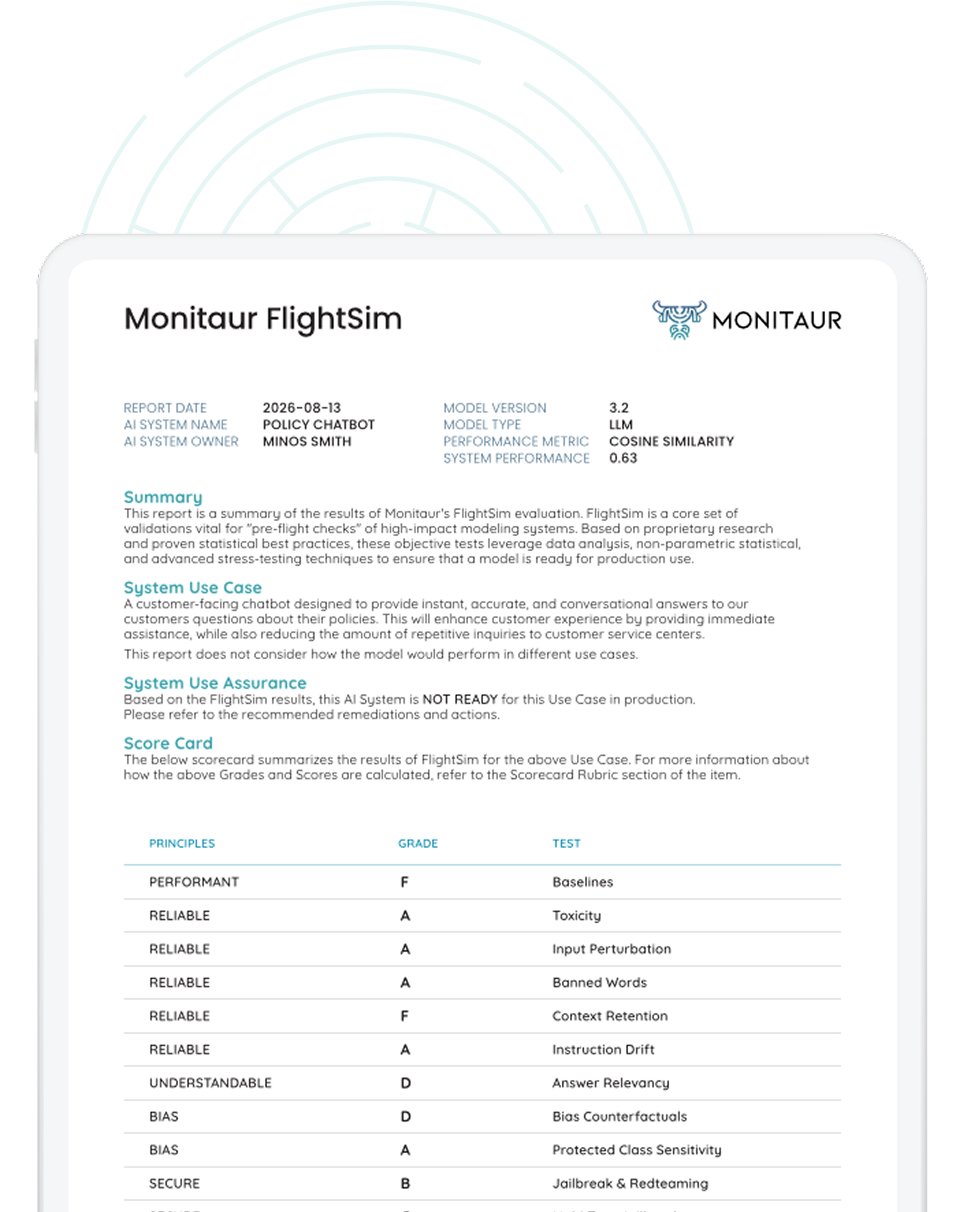
Not a checklist. An AI pen test. FlightSim operates like a pre-deployment AI pen test. Using real data augmented with synthetic scenarios and simulations, it applies an opinionated battery of statistical and adversarial tests against the system's intended use, then pushes it into conditions it has never been asked to handle to identify where performance degrades and risks require attention.




.svg)


Policies matter. Controls matter. Documentation matters. But for high-impact AI, they aren't the end of the story. FlightSim provides an automated, objective opinion informed by Monitaur’s expertise.
Bring us a high-impact AI system you need greater confidence in. We'll work with you to understand the use case, define what needs to be evaluated, and determine whether FlightSim is the right assessment approach.
AI risk isn't abstract. A model that performs well in one environment can behave very differently against another organization's data, users, and operating conditions. So FlightSim tests your system in your context, and it does that without turning into a big project.
Keep control of your data
No source code or model weights required
We bring the scenarios
A limited dataset doesn't limit the assessment
BLACK-BOX TESTING
We test from the outside in
Test what your own team can't
We help you test sensitive data
Bring a system and a description of what it's supposed to do. We handle the rest. No need to design it, maintain it, or have your data science team standing by to interpret it.
Finding failure isn’t the end goal; identifying risk is. By mapping safe operating boundaries, FlightSim helps you understand the conditions in which your system can be trusted to do its job and where risks require attention.
With FlightSim you learn:

What we evaluate
Every FlightSim test maps to Monitaur’s principles of well-built AI systems and aligns with guidance found in the NIST AI RMF, ISO 42001, and EU AI Act. The same principles run through risk quantification, reporting, and objective validation, so one language carries across your whole program.
Does it hold up when inputs shift, degrade, or arrive in ways nobody planned for?
Can it be jailbroken, coerced, or made to leak sensitive information?
Does it perform consistently across relevant populations and conditions?
Can the results be explained, reproduced, and owned by people who didn't build it?
Does the system meet its requirements in the environment where it actually runs?
SOC 2 TYPE II · NAIC AIS PROGRAM · NIST AI RMF · ISO/IEC 42001 · EU AI ACT
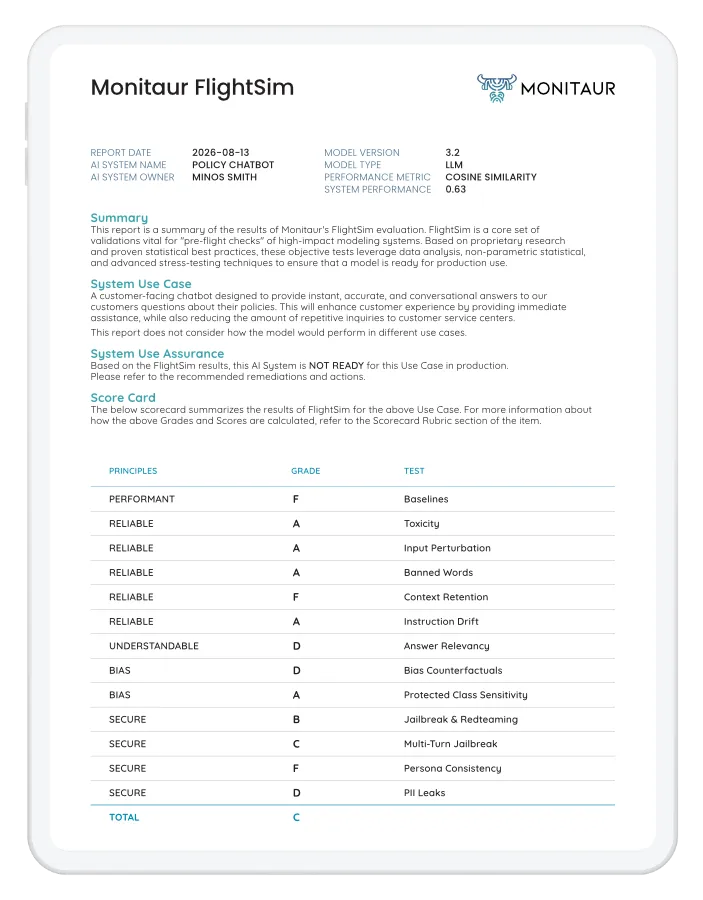
You get a FlightSim Report: a letter grade for every principle, the safe operating region for the system, and a clear recommendation on whether it's ready for production. It does all of this while also providing evidence you can use to satisfy your AI Governance requirements.
How can the same assessment evaluate an underwriting model and a customer-facing chatbot? The short answer is that FlightSim doesn't test domains. It tests against the two things every AI system has: a stated intended use, and the principles above.

Anchored
to purpose
Every test is evaluated against the system's intended use and defined requirements, not against a domain rulebook. That's what lets the same battery say something meaningful about an underwriting model and a claims assistant.

Architecture-
Agnostic
Because FlightSim probes behavior rather than architecture, it doesn't care how the system was built or who built it. The same method applies to a statistical model, a generative application, and a vendor tool you can't see inside.

Statistical,
not editorial
Monte Carlo simulation, non-parametric statistics, and comparison against baseline surrogates. Where a language model is used inside a test, results are aggregated across several independent models so no single evaluator's bias drives the grade.
Is this AI actually ready?
–
The FlightSim Report ends with a recommendation: ready for production, or not yet. You get the grade behind it and the residual concerns that came with it.
Does it perform the way we said it would?
+
The FlightSim Report answers whether your model performs the way you thought it would. You get the grade behind it and the residual concerns that came with it.
What happens outside the scenarios
we expected?
+
The FlightSim Report shows how your model responds outside the scenarios you expected. You see where it holds up, where it breaks down, and the residual concerns that come with it.
Can we show the evidence?
+
The FlightSim Report gives you the evidence behind its recommendation. You get the results, the grade behind them, and the residual concerns that came with it.
We solved it first, in the hardest industry to solve it in. Monitaur has been doing AI governance and assurance in insurance since before most of the category existed, in an industry with the least room for error, under regulators who actually examine. That experience isn't a services layer bolted on after the sale. It's built into the product: the principles, the test battery, the control library, and the report your stakeholders read. And it's why the strongest endorsement of Monitaur comes from the people who actually use it.
Forrester's only Customer Favorite
In the Forrester Wave™: AI Governance Solutions, Monitaur is the category's only vendor named a Customer Favorite. That isn't an analyst's opinion of a roadmap. It's customers' opinion of the actual experience.*
Activated in 90 days
A Fortune 200 insurer's AI governance program had been sitting inside a $500K, six-month consulting engagement with nothing operational to show for it. Monitaur got it moving in 90 days. They renewed for three more years.
* In the Forrester Wave™: AI Governance Solutions, Monitaur is the category's only vendor named a Customer Favorite. That isn't an analyst's opinion of a roadmap. It's customers' opinion of the actual experience.
“FlightSim was very easy to use… [I was] very surprised at the speed of execution and how easy it was to connect.”
— Data Science Executive, Fortune 100 insurer